
CPRA Framework and Tulare County
The California Public Records Act controls how county departments respond to records requests. The Legislature recodified the act in 2023. The new home for the framework is Government Code section 7920.000 and the sections that follow. The recodification kept the substance of the old section 6250 rules. The numbers changed. The presumption of access did not change. Tulare County agencies fall inside this framework. That covers the Sheriff, the County Clerk-Recorder, the Board of Supervisors, county counsel, Public Defender, District Attorney, and the rest of the executive branch at the county level.
The policy section at Government Code section 7922.000 sets the default. Access wins unless the public interest in keeping a record private clearly outweighs the public interest in disclosure, or a statute exempts the record. The court system uses a parallel set of rules. Trial court case access runs through California Rules of Court, Government Code sections 68150 and 68152, and case-by-case rulings. Judicial administrative records sit under California Rule of Court 10.500. Both tracks point at the same goal. Open by default. Closed only when a clear rule says so.
The CPRA chapter is hosted on the official legislature site. The screenshot below shows the entry section that anchors the modern framework.
Open the CPRA entry section on the California Legislative Information site to see the chapter index in full.
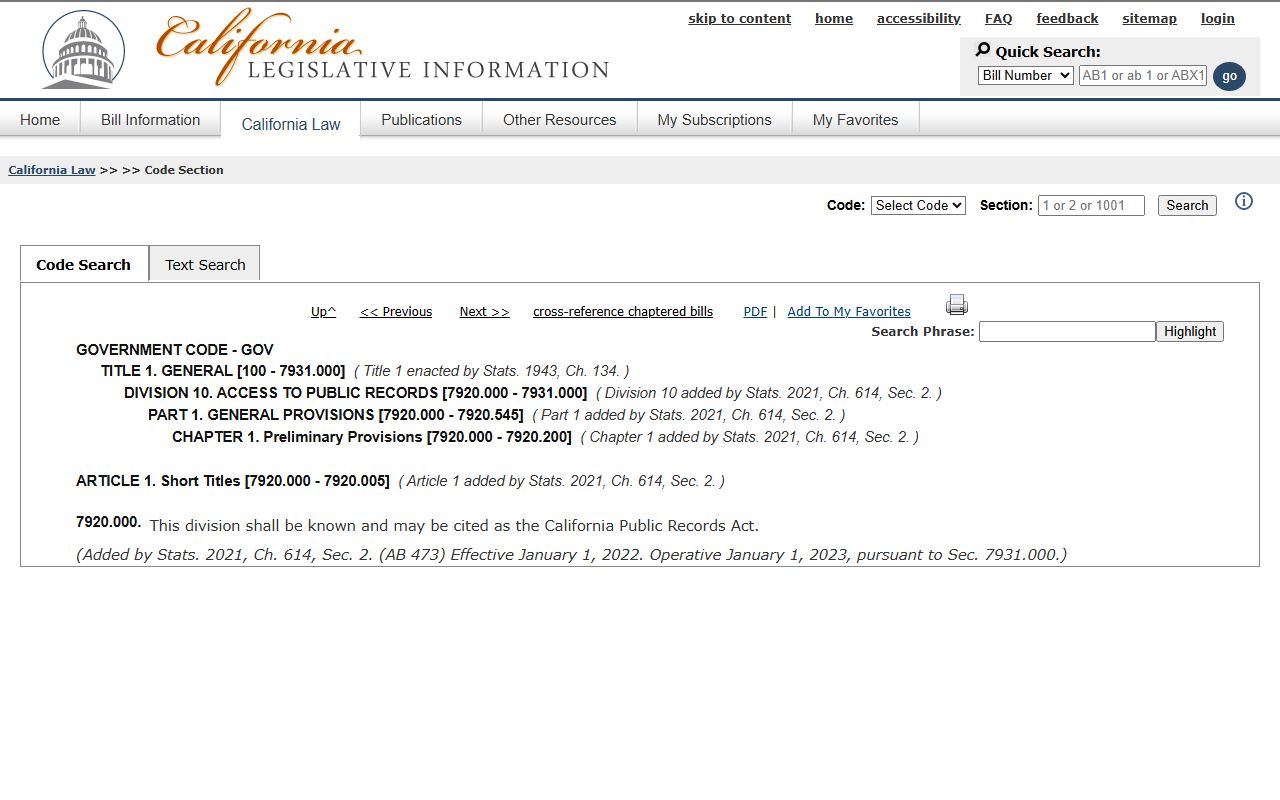
The chapter sets the rules for state and local agencies. County departments inside Tulare County use the same statute the rest of California uses. The same is true for the policy and timing sections that follow.
How to File a Public Records Request in Tulare County
The process is short on paper. Most agencies accept a written request by mail, email, fax, or web form. The CPRA does not require a special form. It does require that the agency take the request seriously and respond on time. The steps below map the path most requesters use when they want a record from a Tulare County department or from the Superior Court.
- Pick the right office. Court case files go to the Tulare Superior Court records request page. Recorded documents and vital records go to the Tulare County Assessor/Clerk-Recorder. Sheriff records go to the Sheriff's Records Unit through the Sheriff's Office. Other county records go to the department that holds them.
- Describe the record. The CPRA does not require a case number, but a clear description shortens response time. Name the topic, the date range, the party names if any, and the format you want.
- Choose a delivery method. Most offices accept mail. Many accept email. The Tulare Superior Court records page also accepts an online request and an in-person walk-in at the Visalia public counter.
- Include your contact information. Provide a name, a mailing address, a phone number, and a valid email. The agency needs a way to send the determination letter or the records.
- Ask for a fee estimate. Some agencies charge for duplication. Some charge for staff time when the work involves data extraction or programming.
- Send the request. Mail goes to the office address. Email goes to the address the agency publishes. The Superior Court records page lists separate mail addresses for case numbers that begin with V and case numbers that begin with P.
- Wait for the determination. County agencies have ten days under Government Code section 7922.530 to decide whether disclosable records exist. The agency may extend in unusual cases.
- Pay the fee, pick up the records, or follow the appeal path. If the agency denies a record in full, ask for the statute or rule that supports the denial. CPRA denials can be challenged in superior court.
The court records office uses a slightly different timeline. Online and mail copy requests run about 15 business days from the date the court receives both the request and the payment. Online staff reach out in 24 to 48 hours after a request comes in. The CPRA ten-day rule does not apply to court copy work. It applies to county agency files outside the judicial branch.
County Agency Records vs Court Records in Tulare County
The split between agency and court records matters for every Tulare County public records request. The rules are not the same. The offices are not the same. The fee schedules are not the same. The table below maps the basic divide.
| Topic | County Agency Records | Court Records |
|---|---|---|
| Governing law | CPRA at Gov. Code 7920.000 et seq. | CRC 2.503, 2.550, 2.551, 10.500, and Gov. Code 68150 and 68152. |
| Who holds the file | Sheriff, Clerk-Recorder, DA, Public Defender, county departments. | Tulare Superior Court clerk in Visalia or Porterville. |
| Response time | Ten days to determine, with possible extension. | About 15 business days after request and payment. |
| Search by | Topic, date range, names, incident number. | Case number first; name search if needed. |
| Form | No required form; written request is enough. | Court records request page or in-person counter. |
| Common denials | Privacy, ongoing investigation, attorney-client. | Sealed, juvenile, adoption, redaction by rule. |
People often start at the wrong office. A divorce case file is a court record, not a Clerk-Recorder record. A marriage license is a Clerk-Recorder record, not a court record. A jail booking sheet is a Sheriff record. A judge's order in the same case sits with the court clerk. The right office is the office that created the document.
Judicial Administrative Records Under Rule 10.500
Court case files are one category. Judicial administrative records are a different category. Budget memos, court statistics, vendor contracts, personnel rules, and internal policies are administrative, not case-related. California Rule of Court 10.500 sets the access rule for those records. It is the closest court analog to the CPRA. The rule lists what counts as administrative, what is open, what is exempt, and how to request.
Tulare Superior Court publishes a Request for Judicial Administrative Records form on its site. The form lists the request structure, copy costs, and the address for submission. The rule borrows the basic CPRA framework. Open by default. Closed only where a specific exemption or balancing rule applies. Personnel files, draft documents, attorney work product, and security-sensitive material are common exemptions. The court may charge for copies and for staff time spent on review.
Common Rule 10.500 topics in Tulare County include trial court budget allocation records, court statistical reports, judicial assignment changes, and contracts the court signed with outside vendors. Case files are not part of Rule 10.500. Those run through the regular records request page. A typical Rule 10.500 request includes the topic, the date range, the office that likely holds the document, and the preferred delivery format.
Tulare County Clerk-Recorder Official Records
The Tulare County Assessor/Clerk-Recorder is a separate executive office, not a court clerk. The Clerk-Recorder maintains birth certificates, death certificates, marriage certificates, marriage licenses, recorded land documents, fictitious business names, CEQA filings, notary registrations, professional registrations, certified interpreter and translator lists, military discharge records, and restrictive covenant modification filings. Tara K. Freitas, CPA, holds the office. She was appointed in April 2021 and elected in June 2022. The office sits at 221 S. Mooney Blvd. in Visalia. The Clerk side is in Room 105 at 559-636-5051. The Recorder side is in Room 103 at 559-636-5050. Lobby hours run 8:00 AM to 5:00 PM. Document filing, certificate issuance, and recording transactions stop at 3:00 PM.
The official records search is hosted at the Tyler-hosted Clerk-Recorder portal linked from the county page. Recorded documents include deeds, deeds of trust, lien releases, UCC filings, maps, and other recordable instruments. The Recorder fee schedule starts at $3.00 for the first page of an official records copy. Each additional page of the same document is $1.00. A certified copy adds $2.00 over the base copy fee.
Recorded land records are public. Recorded UCC filings are public. Vital records have stricter access. Birth, death, and marriage certificate copies are split between authorized and informational copies. Authorized copies go to the parties listed on the record, immediate family, attorneys for parties, and agencies with statutory authority. Informational copies do not show as the original for many legal uses. The Clerk-Recorder page explains the difference for each type of vital record.
Tulare County Sheriff Records
The Tulare County Sheriff's Office publishes a Records Department contact through its community menu. Sheriff records cover incident reports, traffic collision reports, arrest reports, custody status data, booking photos, AB 2761 in-custody death reports, and AB 485 hate crime statistics. The Sheriff also publishes a Top Ten Most Wanted page and a TipNow program for anonymous tips. Sheriff Mike Boudreaux leads the agency. The Detentions Division is led by Captain Buddy Hirayama and runs the Bob Wiley Detention Facility, the Adult Pre-Trial Facility, and the South County Detention Facility.
Sheriff records are county agency records under the CPRA. The same ten-day determination rule applies. Sheriff records also carry investigation-specific exemptions. Penal Code sections protect active investigations, confidential informant identity, undercover officer identity, and certain juvenile arrest detail. Some Sheriff record categories were opened by Senate Bill 1421 and Senate Bill 16, which require disclosure of specific peace officer misconduct findings, use-of-force findings, and dishonesty findings. A request that names a specific officer and a specific category is more likely to draw a clean response than a broad request.
For active custody status and a current snapshot of who is in the Tulare County jail, the Sheriff publishes an inmate listing online. For arrest history and conviction data, the path runs through the court system and the California Department of Justice. The Tulare County criminal records page covers that path.
Confidential Records and Common Exemptions
Some records are closed in full. Others are released with redactions. The list below covers the categories that come up most often in Tulare County public records work.
- Juvenile case files under Welfare and Institutions Code section 827 and California Rule of Court 5.552. Authorized persons may view. Others file form JV-570.
- Adoption records under Family Code section 9200. Access generally requires statutory authority or a court order.
- Sealed court records under California Rule of Court 2.550 and 2.551. A judge must make findings before sealing.
- Arrest sealing under Penal Code section 851.91 for arrests not leading to conviction.
- Factual innocence sealing under Penal Code section 851.8.
- Dismissal relief after probation under Penal Code section 1203.4.
- Mental health and LPS conservatorship records, which hold medical detail kept out of public files.
- Personal identifiers in any case file, including Social Security numbers and financial account numbers, which are redacted under rule.
The court does not run criminal background checks. The court records page makes that point. Conviction history searches run through the California Department of Justice criminal history record review process at oag.ca.gov. The DOJ process uses fingerprints and statutory authority for the requester.
Note: A clear citation to the source statute or rule strengthens a Tulare County public records request and shortens the back-and-forth with the agency.
Response Timelines and Fees for Tulare County Public Records
Two clocks run side by side. The CPRA clock starts at ten days for the initial determination. The court copy clock runs about 15 business days from receipt of the full request and payment. The fee tables also live in two places. County agency fees follow the CPRA cost-recovery rule. Court copy fees follow the Tulare Superior Court records request page. Recorder copy fees follow the Tulare County Recorder fee schedule. The table below pulls the main fees from the published sources.
| Item | Fee |
|---|---|
| CPRA copy charge for direct cost of duplication | Set by the agency, limited to actual cost of duplication. |
| Court certified divorce decree or dissolution judgment | $15.00 |
| Court divorce decree or dissolution judgment for a public agency | $10.00 |
| Court certified document other than dissolution judgment | $40.00 plus copy charges |
| Court non-certified document copy | $0.50 per page per side |
| Court clerk search beyond 10 minutes per name | $15.00 |
| Recorder official records copy, first page | $3.00 |
| Recorder official records copy, each additional page | $1.00 |
| Recorder certified copy additional fee | $2.00 |
| Recorder special information request | $69.00 per hour, quarter-hour minimum |
The CPRA response timing section at Government Code section 7922.530 sets the basic ten-day rule. An extension up to 14 more days is allowed for unusual circumstances, such as the need to search a remote site, the need to consult with another agency, or the need to review a large volume of records. The retention statute at Government Code section 68152 sets retention periods for trial court records. Older files may be destroyed under that statute, and the court records page says the clerk can confirm what was destroyed and when.
The Recorder fee page is the source for recorded document fees. The screenshot below shows the published schedule on the official county page.
Open the official Recorder fee page for the full schedule with SB2, transfer tax, and subscription rates.
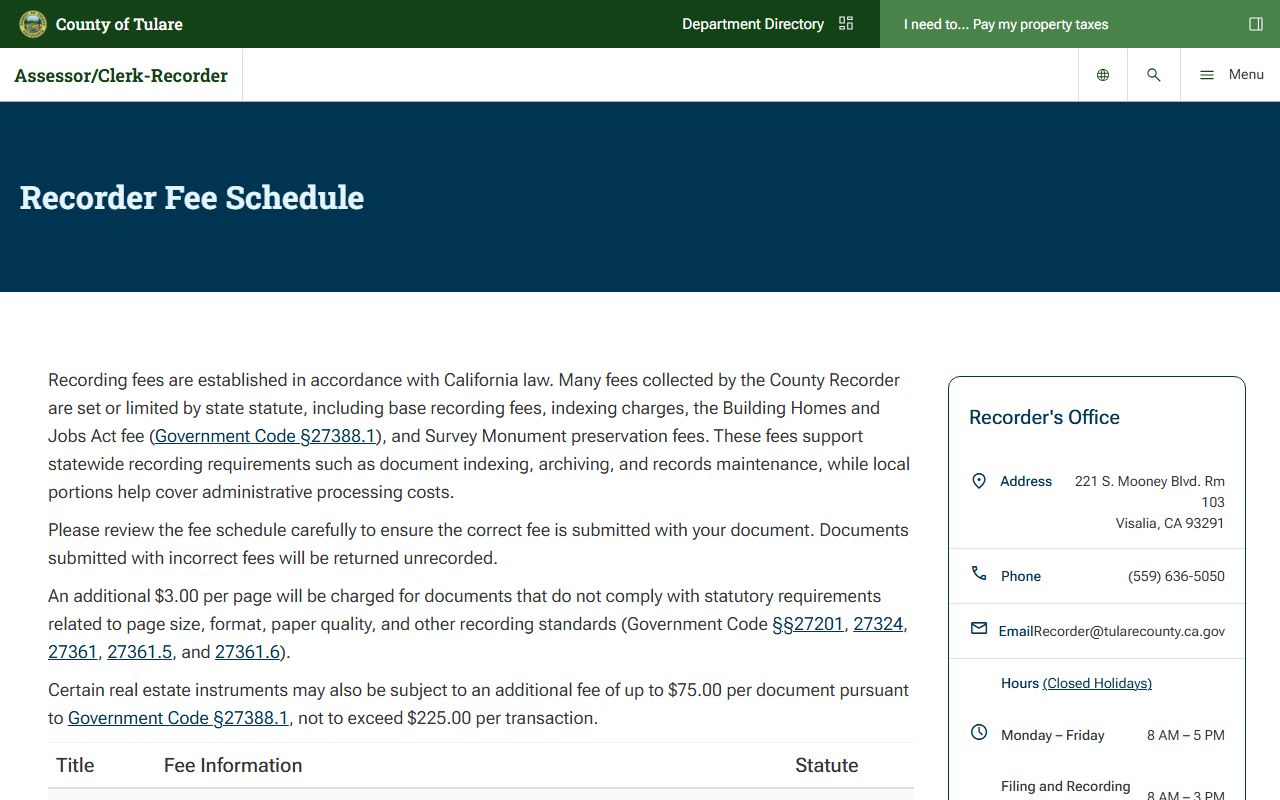
The Recorder fee schedule is set by statute and county resolution. The numbers above match the published Tulare County page at the time of research.
Common Tulare County Records by Agency
The right office depends on the record. The list below points to the place to start for the most common requests in Tulare County.
- Court case files, dockets, and certified case documents: Tulare Superior Court clerk in Visalia or Porterville. See Tulare County court records for the search workflow.
- Marriage license and marriage certificate: Tulare County Clerk-Recorder, 221 S. Mooney Blvd., Room 105, Visalia. See the Tulare County marriage and divorce records page.
- Birth and death certificates: Tulare County Clerk-Recorder vital records.
- Recorded deeds, deeds of trust, liens, UCC filings, maps: Tulare County Recorder, Room 103.
- Sheriff incident, arrest, and collision reports: Tulare County Sheriff's Records Unit.
- Jail booking and custody status: Tulare County Sheriff inmate listing.
- District Attorney case data, press releases, and victim services: tulareda.org at 559-636-5494.
- Public Defender case information: Tulare County Public Defender at 559-636-4500.
- Statewide criminal history record review: California DOJ record review at 916-227-3849.
For court records work, see Tulare County court records. For the clerk that handles court filings, see Clerk of the Superior Court. For arrest and conviction work, see Tulare County criminal records. For marriage and divorce certificates and decrees, see Tulare County marriage and divorce records.